By George Goodwin
Kombucha has become a popular choice for people looking for alternatives to traditional soft drinks and sugary beverages. But what if you could enjoy the convenience of a kombucha-inspired drink without carrying a bottle, dealing with carbonation, or getting that sharp, vinegary taste? That’s where Kobū kombucha powder comes in.
Kombucha powder offers a convenient way to make a drink with a powdered blend you can mix with water. Depending on the formula, it may contain kombucha-derived ingredients, prebiotics, probiotics, postbiotics, tea extracts, or other functional ingredients. For busy consumers, wellness enthusiasts, and anyone trying to build better daily habits, this format offers a simple way to add a functional drink to an existing routine.
But what exactly is kombucha powder? How does it compare with traditional kombucha tea? What are its potential benefits, and what should you look for before buying it? Let’s break it all down.
What Is Kombucha Powder?
Kombucha powder is a dry beverage mix designed to dissolve in water or be added to another drink. Depending on how it is manufactured, it may contain dried kombucha, tea-derived ingredients, probiotics, prebiotic fiber, flavorings, sweeteners, or other functional ingredients. Traditional kombucha is made by fermenting sweetened tea with a culture of bacteria and yeast commonly known as a SCOBY. This fermentation process produces organic acids and other compounds that contribute to kombucha’s distinctive flavor and composition.
Kombucha powder takes a different approach to convenience. Instead of opening a ready-to-drink bottle, you prepare a serving by mixing the powder with liquid. However, not all kombucha powders are the same. Some focus on dried kombucha ingredients, while others use a broader formula that combines selected ingredients for digestive wellness.
How Is Kombucha Powder Different From Traditional Kombucha?
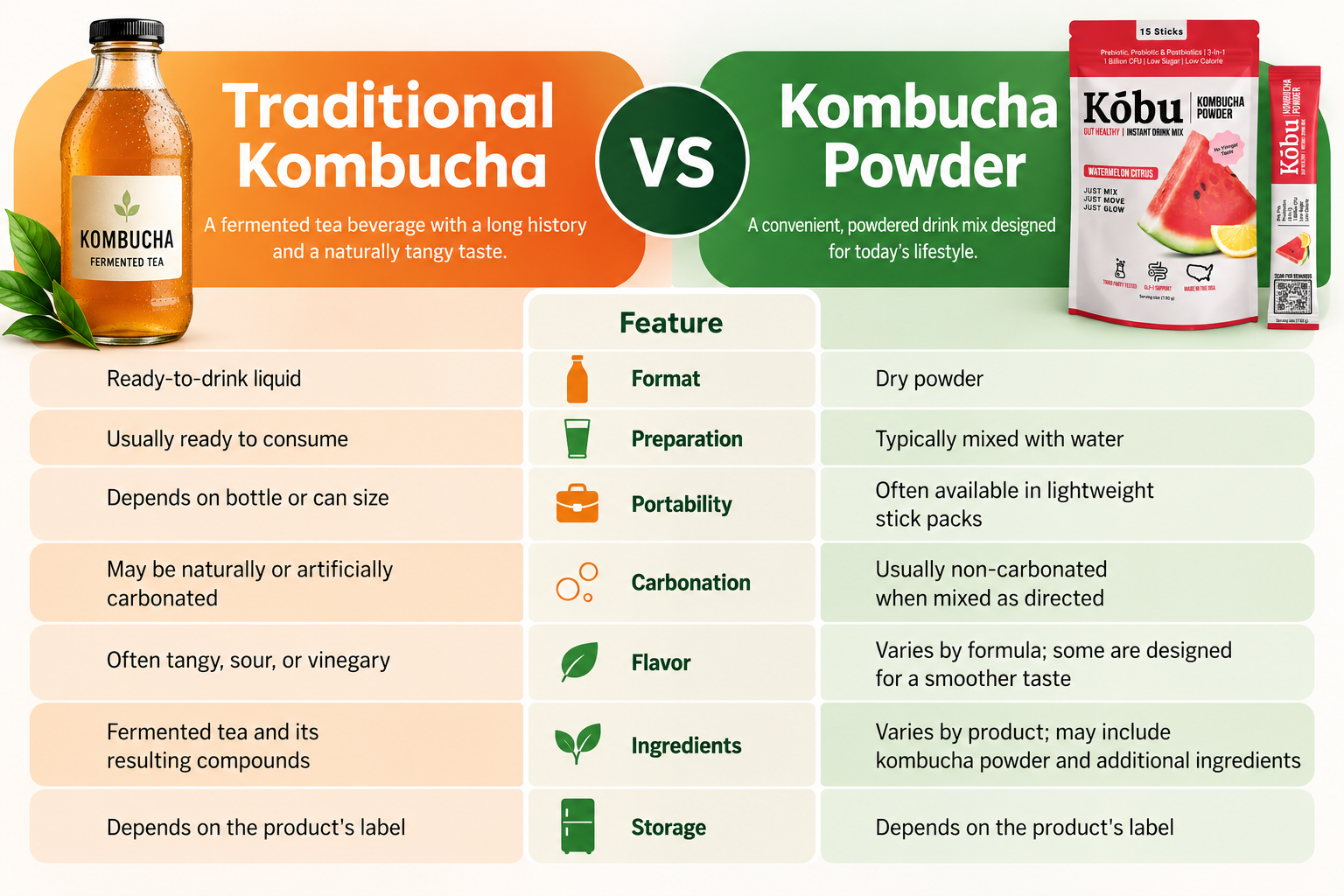
Traditional kombucha is a ready-to-drink fermented beverage. Kombucha powder is a dry mix that you prepare when you want a drink. The biggest difference is convenience. A powdered mix can be easier to carry, store, and prepare when you're traveling, working, or exercising. Still, a powdered product is not automatically nutritionally equivalent to a bottle of fermented kombucha. The ingredients, processing methods, and nutritional profile matter.
What Are the Potential Benefits of Kombucha Powder?
The potential benefits of kombucha powder depend on its actual ingredients. A product containing probiotic strains, for example, may have a different purpose from a powder made primarily with dried tea or kombucha. Here are the main areas to understand.
1. Convenient Support for Digestive Wellness
Many kombucha powder products are marketed for gut health. Some contain probiotics, which are live microorganisms that may provide health benefits when consumed in adequate amounts, depending on the strain and formulation. Other products include prebiotic ingredients, such as certain types of dietary fiber, that can be used by microorganisms in the gut. These ingredients are not interchangeable. Their effects depend on the specific ingredient, amount, and product formulation.
What to look for: Check whether the product identifies its probiotic strains, the amount provided per serving, and any available quality or stability testing.
It's also important to remember that kombucha itself has not been conclusively shown to deliver every digestive benefit commonly advertised. More human research is needed to establish many of the claims associated with kombucha consumption.
2. A Practical Way to Build a Daily Wellness Routine
One of the clearest advantages of kombucha powder is convenience. Individual stick packs can fit into a work bag, gym bag, or travel kit. That makes it easier to prepare a drink without carrying a large bottle or finding a refrigerated beverage. For example, you could keep a serving at your desk, pack one before a workout, or take a few with you when traveling. Convenience does not guarantee a health benefit, but it can make a routine easier to maintain.
3. A Low-Sugar Beverage Option
Some kombucha powders are formulated with less sugar than many sweetened beverages. This may appeal to people who want more control over their daily sugar intake. However, kombucha powder is not automatically low in sugar. Some products contain added sugars, fruit powders, or other sweetening ingredients. Before buying, review:
Total sugar per serving
Added sugar per serving
Calories per serving
Sweeteners used
Recommended serving size
Compare products using the same serving size so you're making a fair comparison.
4. A Convenient Alternative to Carbonated Drinks
Traditional kombucha is often tangy and may be carbonated. Some people enjoy that flavor, while others prefer a smoother, non-carbonated drink. Powdered formulas can offer an alternative for people who want a flavored beverage without the fizz. The taste depends on the ingredients and the amount of water used. For consumers who dislike kombucha's vinegar-like taste, a flavored powder may be worth trying.
5. Hydration Support Through Everyday Drinking Habits
Kombucha powder is usually prepared with water, so it can become part of a regular hydration routine. Some formulas also contain ingredients such as coconut water powder or electrolytes. These ingredients vary by product, so check the label rather than assuming every kombucha powder provides them. The most important point is simple: drinking a kombucha powder mix can contribute to your fluid intake when prepared with water, but it should not automatically be treated as an electrolyte replacement drink. If you need to replace fluids and electrolytes after prolonged exercise or significant sweating, choose a product formulated for that specific purpose.
6. Potential Benefits From Tea-Derived Compounds
Kombucha is traditionally made with black or green tea. Tea contains naturally occurring compounds, including polyphenols, that have been studied for their antioxidant activity. Some kombucha powders may retain tea-derived ingredients or compounds, depending on the formulation and manufacturing process. However, the amount and type of these compounds can differ significantly between products. You should not assume that every powder provides the same nutritional profile as freshly brewed tea or traditionally fermented kombucha.
What Does the Research Say About Kombucha Benefits?
It's important to separate promising research from proven health outcomes. A systematic review published in Annals of Epidemiology in 2019 examined 310 kombucha-related articles and found only one study reporting empirical research in human subjects at that time. The researchers concluded that many proposed health benefits still needed to be tested in human clinical trials. That review is an important reminder that popular wellness claims can move faster than the science.
Research fact: A 2019 systematic review examined 310 kombucha-related articles but identified only one study reporting human-subject research. The authors called for further clinical trials to test the beverage's claimed health benefits.
Source: Kapp et al., Kombucha: A Systematic Review of the Empirical Evidence of Human Health Benefit, Annals of Epidemiology (2019). This does not mean kombucha powder has no value. It means the product's ingredients, evidence, and intended use deserve careful consideration. Research on traditional kombucha also cannot automatically be applied to every powdered formulation.
Prebiotics, Probiotics, and Postbiotics: What's the Difference?
Some kombucha powders combine prebiotics, probiotics, and postbiotics in one formula. These terms are related, but they describe different things.
What Are Prebiotics?
Prebiotics are substances, often specific types of fiber, that are used by microorganisms in the body and can provide a health benefit. For example, chicory root contains inulin, a type of prebiotic fiber. Depending on the product and serving size, it may help increase dietary fiber intake. People who are sensitive to certain fermentable fibers may experience gas or bloating, particularly when increasing their intake quickly.
What Are Probiotics?
Probiotics are live microorganisms that can provide health benefits when administered in adequate amounts. Not every fermented food or beverage contains the same probiotic strains or quantities. A product's potential effects depend on the microorganisms present, the dose, and the available evidence for the intended benefit. When evaluating a probiotic powder, look for the strain name, amount per serving, and information about product quality and stability.
What Are Postbiotics?
Postbiotics are preparations of inanimate microorganisms and/or their components that provide a health benefit to the host. The term does not simply mean any substance produced during fermentation. The composition and evidence behind a postbiotic ingredient matter. If a product claims to contain postbiotics, review its ingredient information to understand what is included and what benefits are supported by evidence.
Why Do Some Products Combine All Three?
A formula containing prebiotics, probiotics, and postbiotics is designed to bring different types of ingredients together in one product. That may be convenient for consumers who prefer a single drink mix rather than buying several separate products. However, the phrase “3-in-1” does not automatically prove that a product is more effective. The actual ingredients, amounts, quality, and research behind the formula are what matter.
How to Use Kombucha Powder
One advantage of kombucha powder is how easy it can be to prepare. Always follow the product label because serving sizes and mixing instructions differ between brands.
1. Mix It With Water
This is the simplest option.
Add the recommended amount of powder to water.
Stir or shake until it dissolves.
Adjust the water volume only as permitted by the product's instructions.
Enjoy it as part of your usual beverage routine.
For Kōbu, the product website recommends mixing one stick with 8–12 ounces of water.
2. Add It to a Smoothie
Some powdered kombucha blends can be mixed into smoothies. This can be useful if you already prepare fruit, yogurt, or other smoothie ingredients. Before blending, check whether the manufacturer recommends this use and whether the formula is suitable for the temperature and ingredients involved.
3. Mix It Into Iced Tea
If the powder is designed to dissolve in tea, you can use it to create a flavored drink. Check the label before mixing it with hot liquids, especially if the formula contains live probiotic microorganisms. Heat can affect the viability of some probiotics.
4. Make a Simple Mocktail
For a refreshing non-alcoholic drink, mix the powder with water according to the instructions, then add ice or a permitted garnish such as a lemon slice. Avoid adding extra sweeteners automatically. Taste the drink first, especially if the powder is already flavored.
5. Take It Along When Traveling
Single-serve packs can be convenient for hotel stays, road trips, workdays, or other situations where carrying bottles is less practical. Keep the powder sealed and store it according to the manufacturer's instructions. Portability does not remove the need to protect the product from moisture, heat, or other unsuitable storage conditions.
When Is the Best Time to Drink Kombucha Powder?
There is no universally established best time to drink kombucha powder. It depends on your routine, the ingredients, and the manufacturer's directions. Some people prefer to have it in the morning. Others drink it with lunch, after a meal, or as an afternoon alternative to a sweetened beverage. A few practical guidelines can help:
Morning: Pair it with breakfast or your usual morning hydration routine.
During the workday: Keep a serving nearby if you want an easy drink option.
Around exercise: Use it as a regular beverage if the product suits your needs, but do not assume it replaces a purpose-formulated sports drink.
After meals: Follow the label and pay attention to how your body responds.
If a formula contains prebiotic fiber and you are sensitive to it, start with the labeled serving guidance and monitor your tolerance. Do not exceed the recommended amount simply because the product is marketed for daily wellness.
Kombucha Powder vs. Kombucha Tea vs. Probiotic Supplements
Which option makes the most sense? That depends on what you want from the product.
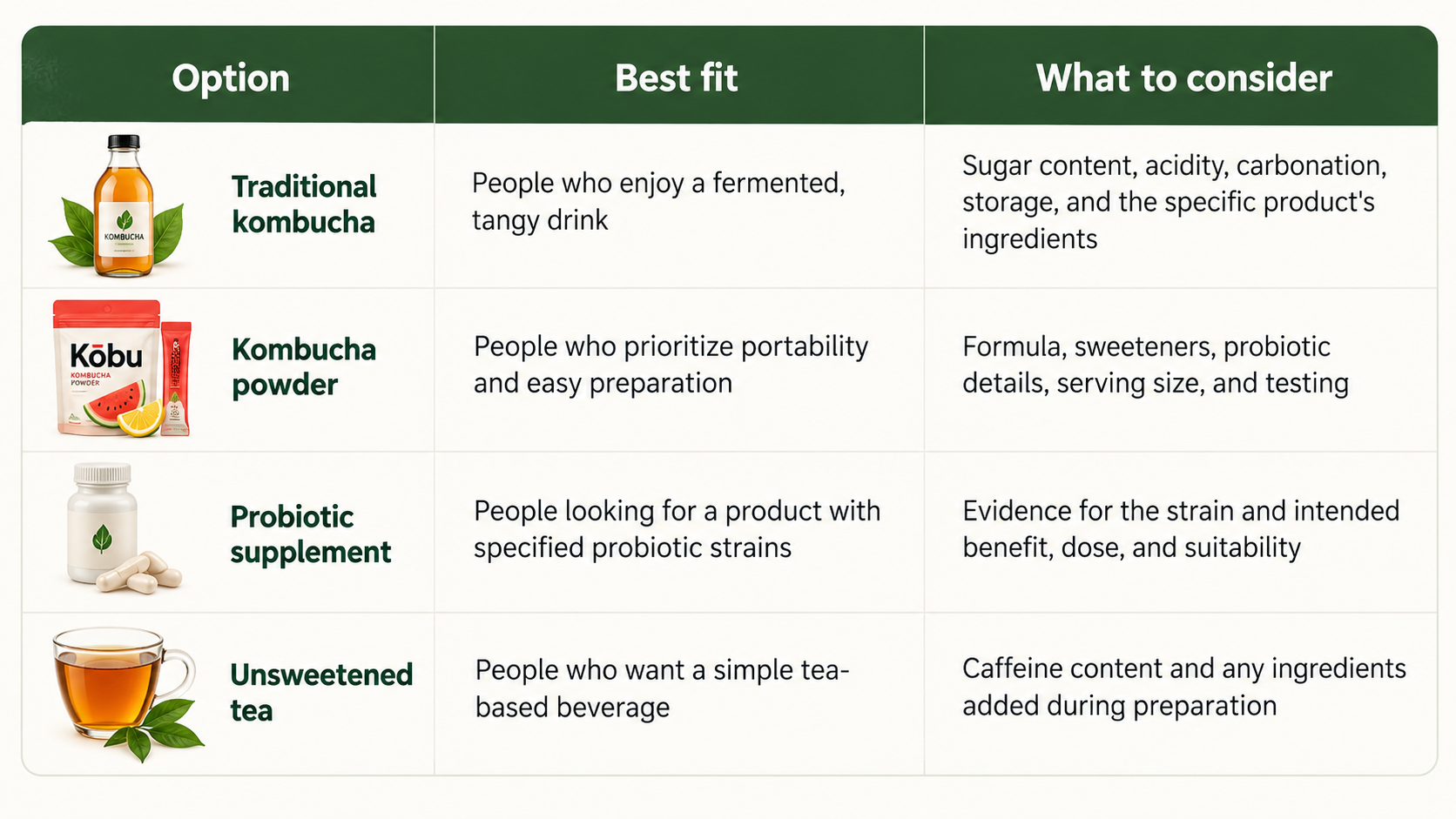
These options are not direct substitutes in every situation. A kombucha powder may contain ingredients that are not present in traditional kombucha, while a probiotic supplement may provide specific strains in a different dose or format.
The best choice is the one that fits your needs, preferences, and budget without relying on unsupported health promises.
Meet Kōbu Kombucha Powder
For consumers interested in a convenient, low-sugar kombucha-inspired drink mix, Kōbu Kombucha Powder is one option to explore. Kōbu is designed around a portable stick-pack format and a formula that combines prebiotics, probiotics, and postbiotics. Its website lists ingredients such as organic kombucha powder, organic chicory root fiber, green tea ingredients, stevia, and organic lemon. Coconut juice is listed for the Lemon Ginger flavor, while beet powder is listed for Watermelon Citrus. The product is available in Lemon Ginger and Watermelon Citrus flavors.
What Makes Kōbu Convenient?
Portable format: Individual sticks are easy to carry.
Simple preparation: Mix a stick with water according to the product instructions.
Low-sugar positioning: Check the current nutrition label for the exact sugar and calorie content.
Multiple ingredients: The formula combines prebiotic, probiotic, and postbiotic ingredients.
Flavor options: Choose between Lemon Ginger and Watermelon Citrus.
As with any functional beverage, the exact benefits depend on the ingredients and the evidence supporting them. Kōbu should be viewed as a convenient drink mix, not as a treatment for digestive conditions or a replacement for medical care. Learn more about Kōbu Kombucha Powder at www.enjoykobu.com.
Are There Any Side Effects or Precautions?
Kombucha powder is not automatically suitable for everyone. Its potential side effects depend on the formula and the individual.
For example:
Digestive discomfort: Certain prebiotic fibers can cause gas, bloating, or other digestive symptoms in some people.
Added ingredients: Sweeteners, flavorings, caffeine-containing tea ingredients, or other components may not suit everyone.
Probiotic considerations: Probiotics are not risk-free for every person. People with weakened immune systems or significant underlying health conditions should seek professional advice before using probiotic products.
Pregnancy and breastfeeding: If you are pregnant or breastfeeding, ask a healthcare professional whether the specific product is appropriate for you.
Existing health conditions: If you take medication or are managing a health condition, review the product's ingredients with a qualified healthcare professional when needed.
Also, do not assume that a powdered product has the same risks, ingredients, or effects as traditionally brewed kombucha. The formulation matters.
Most importantly, do not use kombucha powder as a substitute for medical treatment or a balanced diet.
Frequently Asked Questions About Kombucha Powder
Is kombucha powder the same as regular kombucha?
No. Traditional kombucha is a fermented liquid made from tea, sugar, and a culture of bacteria and yeast. Kombucha powder is a dry mix that may contain dried kombucha or a blend of other ingredients. The nutritional profile and potential benefits depend on the product.
Does kombucha powder help with gut health?
Some formulas contain prebiotics or probiotics intended to support digestive wellness. However, the benefits depend on the ingredients, dose, and supporting evidence. Kombucha-related health claims should not be treated as proven treatments for digestive conditions.
Can I drink kombucha powder every day?
That depends on the product's instructions, ingredients, and your individual needs. Follow the label, avoid exceeding the recommended serving, and consult a healthcare professional if you have a relevant health condition or concern.
Key Takeaways
Kombucha powder is a powdered drink mix designed to be prepared with water or another beverage.
Its ingredients and potential benefits vary by brand and formulation.
Some products combine prebiotics, probiotics, and postbiotics to support digestive wellness.
Powdered formats are portable, convenient, and easy to incorporate into everyday routines.
Kombucha and probiotic-related health claims should be considered carefully because human research remains limited.
Check the ingredient list, sugar content, serving instructions, and quality-testing information before choosing a product.
Kōbu Kombucha Powder offers a low-sugar, portable option designed around prebiotics, probiotics, and postbiotics.
Final Thoughts: Is Kombucha Powder Worth Trying?
Kombucha powder offers a convenient way to prepare a flavored drink without carrying a bottle of ready-to-drink kombucha. Depending on the formulation, it may also provide ingredients such as prebiotic fiber, probiotics, postbiotics, or tea-derived compounds. The key is to look beyond the marketing. Check the ingredient list, sugar content, serving size, quality information, and evidence behind any health claims.
If convenience, portability, and a low-sugar drink mix are important to you, kombucha powder may be worth exploring as part of your everyday routine. For a portable option featuring prebiotics, probiotics, and postbiotics, discover Kōbu Kombucha Powder and explore its available flavors at www.enjoykobu.com.
At Innovar Marketing Agency, we believe better consumer education helps people make more informed choices about emerging food, beverage, and wellness products.