The Complete Guide to Integrated Retail Software Features for Grocery Stores
By George Goodwin
Running a grocery store today involves much more than keeping shelves stocked. Independent grocers and supermarket operators have to manage pricing, inventory, suppliers, customer loyalty, promotions, employees, payments, and increasingly, online orders. When every part of the business uses a separate system, information gets scattered—and small problems can quickly turn into lost sales and wasted time.
That's where integrated retail software comes in. Instead of having your Point-of-Sale system, inventory software, loyalty program, pricing tools, and reporting platforms operate independently, integrated grocery software connects them so they can share information automatically.
The result is a smarter, more connected operation. In this guide, we'll look at the most important integrated retail software features for grocery stores, what each feature does, how the systems work together, and what grocery retailers should consider before investing.
What Is Integrated Retail Software?
Integrated retail software connects multiple systems used to operate a grocery store and allows them to share data. Think of it as a central technology ecosystem rather than a collection of disconnected tools. A modern integrated grocery software environment may connect:
Point-of-Sale (POS)
Inventory management
Pricing
Electronic Shelf Labels (ESLs)
Loyalty programs
Customer data
Purchasing and ordering
Supplier management
Online ordering
Retail analytics
Accounting
Marketing platforms
The goal is simple: one connected flow of information across the business. For example, when a customer purchases a product, the sale can update inventory, record loyalty activity, feed sales analytics, and help inform future purchasing decisions. That's much more powerful than entering the same information into several different systems.
Why Integrated Grocery Software Matters
Many independent grocers don't necessarily have a technology shortage. They have a connectivity problem. You might have a POS system that works well, an inventory platform that works well, and a loyalty program that works well—but if those systems don't communicate, your team may still have to manually move information from one platform to another. Recent industry research highlights this challenge. A 2026 independent-grocery study reported that one in three independent grocers said their POS was only somewhat or not well integrated with their other tools. That's important because the value of grocery technology isn't just having more features. The real value comes from making those features work together.
The Essential Features of Integrated Retail Software
Not every grocery store needs every technology available. However, there are several core features retailers should evaluate when choosing an integrated grocery software solution.
1. Grocery POS Integration
The POS Is the Center of the Operation
Your Point-of-Sale system is one of the most important pieces of grocery technology in your store. A modern grocery POS should do more than process payments. It should communicate with:
Inventory
Pricing
Loyalty
Promotions
Customer data
Reporting
Accounting
Every transaction creates valuable information. When that information automatically flows into the rest of your technology ecosystem, your store can respond faster.
Look for These POS Features
Consider:
Real-time sales reporting
Multiple payment options
Digital coupons
Loyalty integration
Inventory synchronization
Multi-location support
EBT support where applicable
Variable-weight product support
Open API or integration capabilities
Action Tip
Before choosing new grocery software, make a list of every system currently connected to your POS. Your new platform should improve those connections—not break them.
2. Inventory Management Integration
Know What You Have—and What You Need
Inventory is one of the biggest challenges in grocery retail. Too much inventory can lead to:
Spoilage
Waste
Storage costs
Markdown requirements
Too little inventory can lead to:
Stockouts
Lost sales
Frustrated customers
Integrated inventory management gives store operators better visibility into what's selling and what needs to be reordered.
Important Inventory Features
Look for:
Real-time inventory tracking
Automated reorder alerts
Purchase order management
Vendor management
Demand forecasting
Multi-location inventory visibility
Shrink tracking
Perishable inventory management
Accurate inventory data can directly affect sales. A 2025 grocery-retail study covering about 24,000 SKUs across 11 stores found that inventory audits produced an 11% store-wide sales lift, with the benefit concentrated among products where recorded inventory overstated actual stock. The lesson is simple: better inventory accuracy can be a sales strategy, not just an operations task.
3. Pricing Management
Make Pricing Easier to Control
Grocery prices change constantly. Retailers may need to manage:
Regular pricing
Promotional pricing
Loyalty pricing
Clearance pricing
Seasonal pricing
Multi-store pricing
Integrated pricing software allows changes to flow across the systems that need them. That reduces manual work and helps maintain pricing consistency.
What to Look For
Your system should support:
Centralized price management
Scheduled price changes
Promotion management
Multi-location pricing
Margin monitoring
POS synchronization
4. Electronic Shelf Label Integration
Connect Digital Pricing to Your Store Systems
Electronic Shelf Labels are becoming an important part of modern grocery technology. Instead of manually replacing paper labels, retailers can update digital shelf labels through connected software. ESL integration can help synchronize:
Pricing → POS → Shelf Label → Promotion
This creates a more connected pricing environment.
Benefits of ESL Integration
Faster price changes
Better pricing accuracy
Reduced manual labor
Faster promotions
Better merchandising flexibility
For grocery stores already considering ESL technology, integration should be a major part of the buying decision.
5. Customer Loyalty Integration
Turn Customer Data Into Better Experiences
Loyalty programs are no longer just about collecting points. Modern loyalty platforms can help retailers understand:
What customers buy
How frequently they shop
Which promotions they respond to
Which categories they prefer
When they are most likely to purchase
When loyalty software connects with POS and marketing platforms, retailers can create more relevant offers. Research cited by McKinsey found that well-designed loyalty programs can drive 4% to 7% incremental revenue while reducing marketing costs by 6% to 8%.
Loyalty Features to Consider
Look for:
Digital coupons
Personalized promotions
Points and rewards
Customer segmentation
Purchase history
Mobile app integration
Email and SMS integration
6. Retail Analytics and Reporting
Turn Data Into Decisions
Your grocery store is generating data every day. The challenge is knowing what to do with it. Integrated retail analytics can help you identify:
Best-selling products
Slow-moving products
Profitable categories
Promotion performance
Inventory turnover
Customer purchasing patterns
Store-level performance
Instead of asking, "What happened?" you can begin asking, "Why did it happen—and what should we do next?"
Important Grocery KPIs
Track metrics such as:
Sales per store
Sales per category
Average basket size
Gross margin
Inventory turnover
Stockout rate
Promotion lift
Customer retention
Repeat purchase rate
7. Purchasing and Supplier Management
Connect Buying With What Customers Actually Purchase
Purchasing decisions become easier when your buying team has access to accurate sales and inventory information. Integrated purchasing software can help with:
Purchase orders
Vendor management
Receiving
Invoice matching
Reorder points
Supplier performance
Cost tracking
This creates a stronger connection between the sales floor and the supply chain.
8. AI and Demand Forecasting
Use Data to Predict What Comes Next
Artificial intelligence is becoming an important part of grocery retail technology. AI can help retailers analyze:
Historical sales
Seasonality
Promotions
Customer behavior
Inventory levels
Demand patterns
These insights can support better decisions around purchasing, pricing, assortment, and promotions. A July 2026 survey of U.S. small and midsize grocery decision-makers found that 93% of respondents were comfortable using AI, while nine in ten surveyed retailers were already experimenting with AI in some form. AI adoption is moving from experimentation toward practical retail applications.
Start With Practical AI
Independent grocers don't need to automate everything immediately. Start with areas such as:
Demand forecasting
Inventory alerts
Sales analysis
Marketing personalization
Then expand as your team becomes comfortable with the technology.
9. Omnichannel and Online Ordering
Connect In-Store and Online Inventory
Today's grocery customer may:
Search for a product online.
Check whether it's available.
Place an order.
Pick it up at the store.
Return later for another purchase.
If your online inventory isn't connected to your physical inventory, customers can encounter inaccurate availability. Integrated grocery software helps synchronize:
Online inventory
In-store inventory
Pricing
Promotions
Customer information
Orders
This creates a smoother omnichannel experience.
10. Accounting and Financial Integration
Connect Retail Operations to Financial Reporting
Financial information should not live in a completely separate world from your retail operation. Integration with accounting systems can help streamline:
Sales reconciliation
Expenses
Vendor payments
Revenue reporting
Inventory valuation
Financial analysis
The more automated these processes become, the less time your team needs to spend moving data manually.
11. Employee and Labor Management
Connect Staffing With Store Activity
Labor is one of the biggest operating expenses for many grocery stores. Integrated systems can help retailers analyze staffing needs based on:
Sales volume
Store traffic
Department performance
Delivery schedules
Peak shopping periods
AI and analytics can also support labor planning and scheduling. This helps retailers put employees where they're needed most.
12. Retail Media and Marketing Integration
Turn Customer Data Into Marketing Opportunities
Integrated grocery software can also support modern grocery marketing. When appropriate permissions and privacy practices are in place, retailers can use first-party customer data to support:
Personalized offers
Email campaigns
Digital coupons
Retail Media Networks
Sponsored promotions
Product recommendations
This creates opportunities for both retailers and CPG brands. For grocery retailers, it can create another revenue stream. For CPG brands, it can provide access to shoppers closer to the point of purchase.
How All These Systems Work Together
The biggest advantage of integrated retail software is what happens when the systems communicate. Imagine this example: A customer purchases a functional beverage.
The POS records the transaction.
↓
Inventory automatically decreases.
↓
The loyalty system records the customer's purchase.
↓
Analytics identify the product as a strong performer.
↓
The inventory system triggers a reorder recommendation.
↓
The retailer uses loyalty data to create a relevant promotion.
↓
The promotion is pushed through the marketing platform.
↓
The Electronic Shelf Label displays the updated promotional price. That's the power of an integrated grocery technology ecosystem.
The Biggest Mistake: Buying Software in Silos
It's tempting to purchase individual solutions whenever a problem appears. Need better pricing? Buy pricing software. Need better loyalty? Buy a loyalty platform. Need better inventory? Buy inventory software. The problem is that you can end up with a technology stack where nothing communicates properly. Instead, think about your technology architecture before purchasing individual tools.
Ask:
Where does our customer data live?
Where does pricing data live?
Where does inventory data live?
Which system is the source of truth?
How do our systems communicate?
What APIs or integrations are available?
The goal isn't to own the most software. The goal is to create the most connected operation.
How to Choose Integrated Retail Software
Before signing a contract, evaluate potential vendors against several criteria.
1. Integration Capabilities
Ask exactly which systems the platform integrates with. Don't accept "yes, we integrate."
Ask:
"How does the integration work, what data is exchanged, and how frequently is it synchronized?"
2. Scalability
Choose technology that can grow with your business. Consider:
More stores
More SKUs
More customers
More employees
Online ordering
Future technology
3. Ease of Use
A powerful platform won't help if employees don't use it correctly. Look for:
Simple interfaces
Good documentation
Training resources
Mobile accessibility
Strong customer support
4. Data Security
Ask vendors about:
Data encryption
Access controls
Backup procedures
Compliance
User permissions
Incident response
Your retail systems contain valuable business and customer information.
5. Total Cost of Ownership
Don't look only at the monthly subscription. Consider:
Software fees
Hardware
Installation
Integration
Training
Support
Maintenance
Transaction fees
A cheaper platform isn't necessarily cheaper if it creates expensive integration problems later.
A Practical Grocery Software Evaluation Checklist
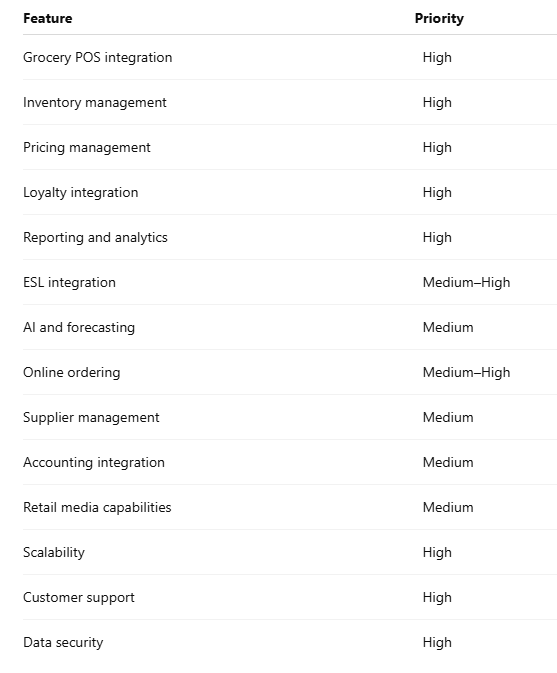
Before choosing a platform, score each vendor on:
Your priorities may vary depending on your store size and business model.
What Integrated Grocery Software Means for Independent Grocers
Independent grocery stores don't have to replicate the technology budgets of national chains. Instead, they should focus on technology that solves their biggest operational problems. For many independent grocers, the best starting point is:
POS
Inventory
Pricing
Loyalty
Reporting
Then add:
ESLs
AI
Online ordering
Retail media
Advanced analytics
as the business is ready. The goal is practical digital transformation, not technology for technology's sake.
The Future of Integrated Grocery Technology
The next generation of grocery software will become even more connected. Expect continued growth in:
AI-powered forecasting
Automated replenishment
Personalized promotions
Dynamic pricing
Smart shelf technology
Computer vision
Connected shopping carts
Retail Media Networks
Predictive analytics
The grocery stores that benefit most won't necessarily be the ones that buy every new technology. They'll be the ones that build a strong foundation and connect the right technologies together.
Key Takeaways
Here are the most important points for grocery retailers:
Integrated retail software connects the systems that run your store.
POS should connect with inventory, pricing, loyalty, and reporting.
Accurate inventory data can directly support sales performance.
Electronic Shelf Labels become more powerful when connected to pricing and POS systems.
Loyalty data can improve personalization and customer retention.
AI can support demand forecasting, inventory, pricing, and marketing decisions.
Omnichannel integration helps synchronize online and in-store experiences.
Retail Media Networks can create additional revenue opportunities.
Don't evaluate software features individually—evaluate how the systems work together.
Prioritize integration, scalability, security, usability, and total cost of ownership.
Build a Smarter Grocery Store—One Connected System at a Time
The future of grocery retail isn't about having the most technology. It's about having the right technology connected in the right way. An integrated grocery software strategy can help independent grocers reduce manual work, improve inventory accuracy, create better customer experiences, personalize promotions, and make faster business decisions. And the opportunity is only getting bigger. As AI, Electronic Shelf Labels, loyalty platforms, retail analytics, and automation continue to develop, connected grocery stores will have more tools than ever to compete with larger chains. Start with your biggest operational problem. Choose technology that solves it. Then connect that technology to the rest of your business. That's how independent grocers can build a smarter, more efficient, and more competitive retail operation.
Ready to Grow Your Grocery Store or CPG Brand?
Technology can make your grocery operation smarter—but customers still need a reason to choose your store or product. That's where marketing comes in.
Visit Innovar Marketing Agency to learn how Innovar helps grocery stores, supermarkets, convenience stores, retailers, and CPG brands grow through SEO, content marketing, local SEO, social media, lead generation, and retail-focused digital marketing.
For brands and retailers looking to capitalize on the growing health and wellness category, visit Kobu Kombucha Powder to learn more about Kobu and its convenient functional beverage format.