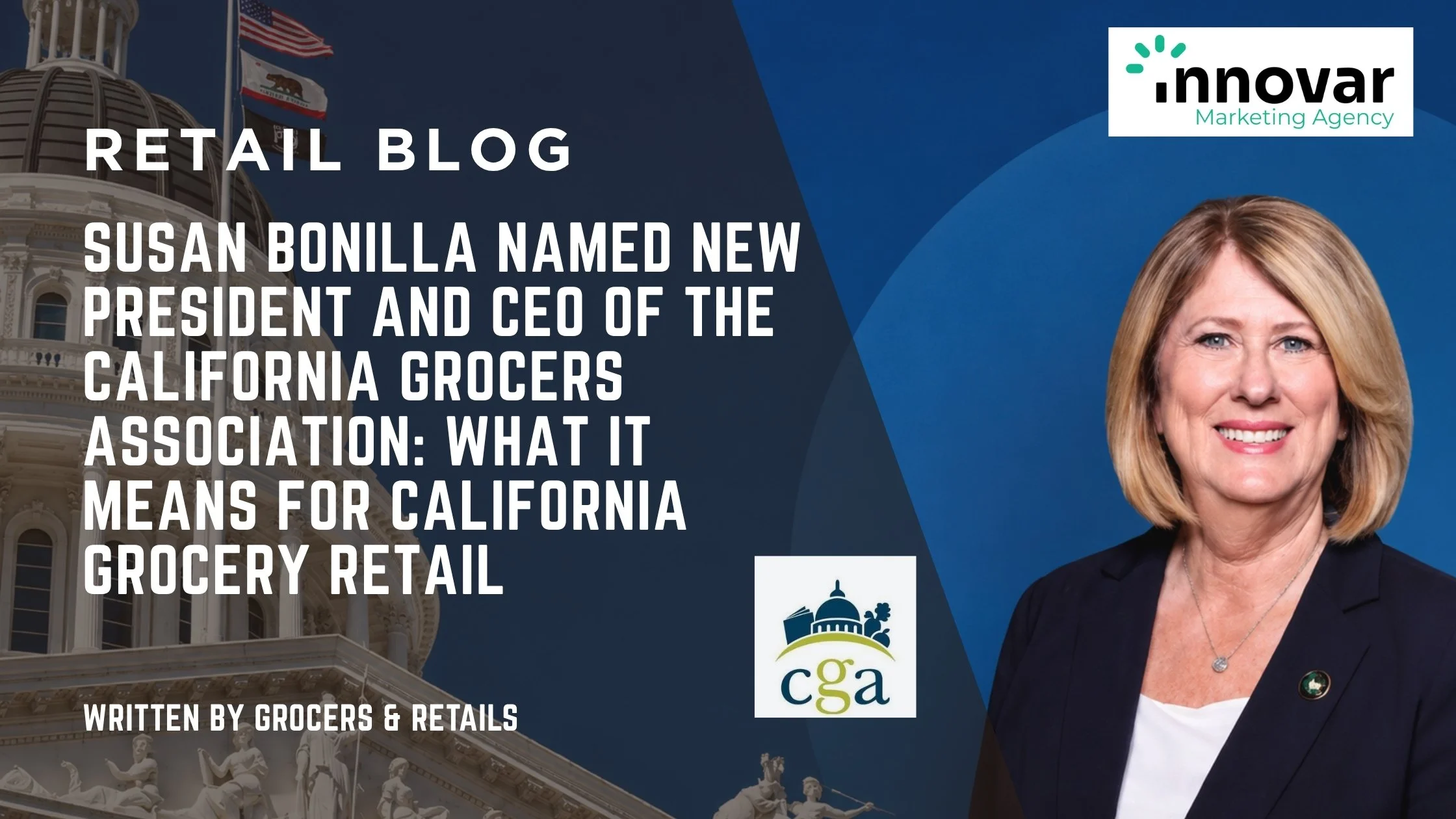
Susan Bonilla Named New President and CEO of the California Grocers Association: What It Means for California Grocery Retail
By George Goodwin
California's grocery industry is entering a new chapter. The California Grocers Association (CGA) has announced that Susan Bonilla will become its next President and CEO and President of the California Grocers Association Educational Foundation (CGAEF), effective November 2, 2026. She will succeed Ronald Fong, who is retiring after 19 years leading the organization. For grocery retailers, CPG brands, suppliers, and technology companies working in California, this is more than a leadership announcement. It could be an important moment for the industry.
Bonilla brings a background that is different from many traditional grocery industry executives. She previously served in the California State Assembly, as a Concord City Councilmember and Mayor, and as a Contra Costa County Supervisor. She has also led the California Pharmacists Association since 2020. That combination of government experience, public policy knowledge, and association leadership could be particularly relevant for California's grocery industry, where regulation, affordability, food access, labor, and business costs continue to shape the retail environment.
Why Susan Bonilla's Appointment Matters
The California Grocers Association isn't a small industry organization. CGA represents more than 300 retail members operating more than 6,000 brick-and-mortar food stores, along with approximately 150 grocery supplier companies. The association has represented California's food industry since 1898. That gives CGA a significant role in conversations involving:
Grocery retailers
Supermarkets
Independent grocers
Convenience stores
Food suppliers
State policymakers
Local governments
Regulatory agencies
California is also a uniquely complicated market. CGA says its members operate across a state with nearly 40 million consumers, 540 counties and municipalities, and 231 regulatory agencies. That means grocery retailers have to navigate a long list of rules and policy decisions while still keeping stores affordable, competitive, and profitable. Leadership with strong government and policy experience could therefore matter significantly.
Who Is Susan Bonilla?
Susan Bonilla has spent much of her career working at the intersection of government, public policy, and community issues. Before joining the California Grocers Association, she served:
Six years in the California State Assembly
As a Concord City Councilmember
As Mayor of Concord
As a Contra Costa County Supervisor
As California Director for the Council for a Strong America
As President and CEO of the California Pharmacists Association since 2020
Before entering public office, Bonilla worked as a high school English teacher in Concord and Walnut Creek. This background gives her a different perspective from someone whose career has been exclusively inside grocery retail. And that may be exactly what CGA wants at this point in the industry's development.
What Bonilla Says About the Grocery Industry
One of the most interesting parts of the announcement is Bonilla's own explanation of why the grocery industry matters. She emphasized the industry's role in food access and affordability and noted that grocers are increasingly important to both Californians and elected officials. That statement gives us a clue about the priorities that could shape her leadership. California grocery stores aren't simply retail businesses. They are also:
Food-access points
Major employers
Community businesses
Supply-chain hubs
Economic contributors
Essential parts of local communities
That means grocery policy increasingly touches consumers, businesses, and government at the same time.
What Could This Mean for California Grocers?
It would be too early to predict specific policy priorities before Bonilla takes office. Her appointment becomes effective November 2, 2026, so the industry will have to wait to see how her leadership agenda develops. However, her background suggests several areas will remain important to watch.
1. Grocery Affordability
Food prices remain one of the most visible issues for consumers. Retailers have to balance:
Supplier costs + labor + regulations + operating expenses + margins + consumer affordability
That's a difficult equation. CGA's next chapter will likely continue to involve conversations around how policy affects the cost of operating grocery stores and ultimately the prices consumers see.
2. Food Access
Bonilla specifically highlighted food access as an important issue. For California communities, grocery stores can play a major role in providing access to fresh and healthy food. That makes questions about store locations, community investment, food availability, and affordability particularly important. For independent grocers, this can also create opportunities to position themselves as essential community businesses rather than simply retail locations.
3. Government and Regulatory Relationships
This may be one of Bonilla's biggest potential advantages. Her experience includes serving in the State Assembly, local government, county government, and leading a statewide professional association. CGA's stated role includes government and industry relations for California's food industry. That means Bonilla understands the language of policymakers from direct experience. For grocers dealing with complex regulations, that could be valuable.
Why This Matters to Independent Grocery Stores
Independent grocers often operate differently from large national chains. They may have:
Smaller teams
Tighter margins
Less technology infrastructure
Fewer resources for compliance
Stronger local relationships
More flexibility in decision-making
But regulatory changes can affect everyone. An independent grocer doesn't have to operate thousands of stores to feel the impact of:
Labor regulations
Packaging requirements
Environmental rules
Food safety requirements
Pricing regulations
Local ordinances
Operating costs
That's why industry representation matters. For smaller retailers, a statewide organization can provide a collective voice that would be difficult for an individual store to create alone.
What This Means for CPG Brands
The leadership change isn't only relevant to grocery retailers. It's also relevant to CPG brands trying to enter California grocery stores. Why? Because successful CPG retail growth depends on understanding the environment retailers operate in. An emerging brand needs to think about more than: "How do I get shelf space?" It should also understand:
Retailer economics
Consumer affordability
Distribution
Regulations
Packaging
Merchandising
Retail technology
Category trends
Consumer demand
The better a CPG brand understands the retailer's world, the stronger its retail strategy becomes.
California Grocery Retail Is Becoming More Technology-Driven
Leadership isn't the only thing changing in grocery. California retailers are also evaluating technologies designed to make stores more efficient. These include:
Electronic shelf labels
Integrated POS systems
Inventory management
Loyalty platforms
Retail media
AI forecasting
Automated ordering
Digital promotions
E-commerce
For example, electronic shelf labels can help retailers update prices digitally instead of manually replacing paper tags. Integrated grocery software can connect:
POS → Inventory → Pricing → Loyalty → Customer Data → Analytics
This is becoming increasingly important as retailers look for ways to manage costs while improving the customer experience. For independent grocers, the goal isn't to buy every new technology. It's to invest in technology that produces measurable results.
The Next Era of Grocery Retail Will Be About Efficiency
California grocers are operating in an environment where efficiency matters. Retailers have to think carefully about:
Labor hours
Inventory
Food waste
Pricing
Promotions
Customer retention
Store traffic
Margins
Technology can help—but only if it's connected to a clear business objective. For example:
Problem:
Employees spend hours changing paper price tags.
Potential solution:
Electronic shelf labels.
Problem:
Store managers don't have a clear picture of inventory.
Potential solution:
Integrated inventory and POS software.
Problem:
Customers aren't returning frequently enough.
Potential solution:
Better loyalty and customer marketing.
Problem:
Retail promotions aren't generating enough lift.
Potential solution:
Better category analytics and retail media. This is where grocery technology and grocery marketing increasingly overlap.
What CPG Brands Should Watch Next
For CPG companies selling into California grocery stores, the next few months are worth watching. Here are five areas to watch.
1. Retailer Priorities
What are grocery buyers prioritizing? Products that provide:
Value
Convenience
Wellness
Differentiation
Strong sales velocity
will continue to have opportunities.
2. Consumer Affordability
A great product still needs to make sense for the shopper's budget. CPG brands should understand: Retail price + perceived value = purchase decision
3. Retail Technology
Brands should understand how their products fit into retailers' technology ecosystems. For example:
Can your UPC data integrate correctly?
Are your promotions easy to execute?
Can your product work with retailer loyalty programs?
Can retailers measure your sales performance?
Do you have the data buyers want?
Retail-readiness increasingly includes data-readiness.
4. Category Growth
Emerging categories can create opportunities for innovative CPG brands. Areas such as:
Functional beverages
Wellness products
Better-for-you snacks
Convenient nutrition
Natural products
continue to attract attention from consumers and retailers. But emerging brands still need to prove that their products can generate sales.
5. Retail Partnerships
Getting into one store isn't the finish line. The stronger goal is building a relationship with retailers that can lead to: Initial placement → Sales velocity → Reorder → More stores → Expanded distribution. That's why CPG brands should approach retail as a long-term partnership.
What Grocery Retailers Should Do Now
Regardless of who leads the California Grocers Association, retailers can take practical steps today.
1. Review Your Operating Costs
Identify where you're losing money through:
Labor inefficiencies
Food waste
Pricing errors
Overstock
Stockouts
Manual processes
2. Audit Your Technology
Look at your:
POS
Inventory
Pricing
Loyalty
E-commerce
Analytics
Ask whether these systems communicate with each other.
3. Strengthen Customer Loyalty
Your customer data can become a major competitive advantage. Use it responsibly to understand:
Purchase behavior
Customer frequency
Basket size
Promotion response
4. Invest in Retail Marketing
Don't rely entirely on foot traffic. Build:
Local SEO
Email marketing
Social media
Community content
Promotions
Digital advertising
5. Track the Right KPIs
Don't only measure revenue. Track:
Average basket size
Sales per square foot
Gross margin
Inventory turnover
Units per store per week
Customer frequency
Promotion lift
A Leadership Change Is Also a Signal About the Future
The appointment of Susan Bonilla is significant not simply because a new person is taking over. It's significant because of the experience she brings to the role. Her background combines: Government + Public Policy + Community Leadership + Association Management
That could be particularly relevant for an industry navigating complex questions around affordability, food access, regulation, and the cost of doing business. At the same time, grocery retailers are facing another transformation: the shift toward more connected, data-driven, technology-enabled stores. The retailers that succeed will likely be the ones that can manage both sides of the equation: Policy and operations. Affordability and profitability. Technology and customer experience. Efficiency and community.
What Happens Next?
Susan Bonilla officially begins her new role on November 2, 2026. She will succeed Ronald Fong, who is retiring after 19 years at the helm of CGA and CGAEF. Her transition also comes as the CGA Educational Foundation reaches a major milestone. In 2026, CGAEF announced a record $1.15 million in scholarships for the grocery industry. That educational mission will remain part of Bonilla's responsibilities as she takes on leadership of both CGA and CGAEF. For grocery retailers and suppliers, the next few months will be an opportunity to watch how the association's priorities evolve.
Key Takeaways for California Grocery Retailers and CPG Brands
Susan Bonilla's appointment signals a new chapter for one of California's most important grocery industry organizations. Here's what businesses should keep in mind:
Susan Bonilla becomes CGA President and CEO on November 2, 2026.
She brings extensive government and public-policy experience.
CGA represents more than 6,000 food stores through its retail membership.
Food affordability and access are clearly important issues in the industry's policy conversation.
Independent grocers should continue focusing on efficiency and technology.
CPG brands should pay attention to retailer economics and consumer value.
Grocery technology, customer data, and retail marketing will continue to shape competitive advantage.
The leadership transition is worth watching as California's grocery industry enters its next phase.
Final Thoughts
Susan Bonilla's appointment comes at an important time for California grocery retail. The industry is dealing with changing consumer expectations, affordability concerns, technology adoption, operational pressure, and an increasingly complex regulatory environment. Bonilla's government and policy background could give the California Grocers Association a different perspective as it represents the industry's interests in Sacramento and across the state. But leadership alone won't determine what happens next. Grocers, suppliers, CPG brands, technology companies, and policymakers will all have a role in shaping the next chapter of California grocery retail.
For retailers, the opportunity is clear: Become more efficient. Understand your customers. Invest in the right technology. Protect your margins. And stay close to the communities you serve.
For CPG brands: Understand the retailer's world before asking for shelf space.
And for everyone in the grocery ecosystem, one thing is becoming increasingly clear: The future of grocery retail will be shaped by the intersection of policy, technology, affordability, innovation, and consumer demand.
How Innovar Helps Grocery and CPG Businesses Grow
The grocery industry is changing quickly—and marketing needs to change with it. Innovar Marketing Agency helps grocery stores, retailers, supermarkets, and CPG brands develop digital marketing and growth strategies designed to increase visibility, attract customers, and support retail expansion. From SEO and content marketing to paid advertising, retail marketing, lead generation, and CPG growth strategy, Innovar helps businesses turn changing market conditions into opportunities.
For CPG brands interested in functional beverages and wellness products, you can also explore Kōbu Kombucha as an example of an emerging product positioned around convenience, wellness, and everyday routines. The grocery industry is changing. The brands and retailers that understand where it's going will be the ones best positioned to grow.