How Jacqueline Smith Built E3 Energy Cubes With Math, Grit, and Clean-Label Discipline (Lessons for Grocery Retailers & CPG Founders)
By George Goodwin
Most snack brands start in the kitchen. Jacqueline Smith started with math. She’s an accountant by training who looked at the protein bar aisle and thought: why does healthy either taste bad—or taste good but wreck your body? That simple question turned into E3 Energy Cubes, a refrigerated, clean-label protein bar now sold through major retail channels. This story matters if you’re a grocery retailer, buyer, or CPG founder trying to build (or stock) brands that actually move off shelves.
If you think you need a culinary degree to disrupt the food industry, think again. Sometimes, you just need a spreadsheet, a calculator, and the guts to bet on yourself.
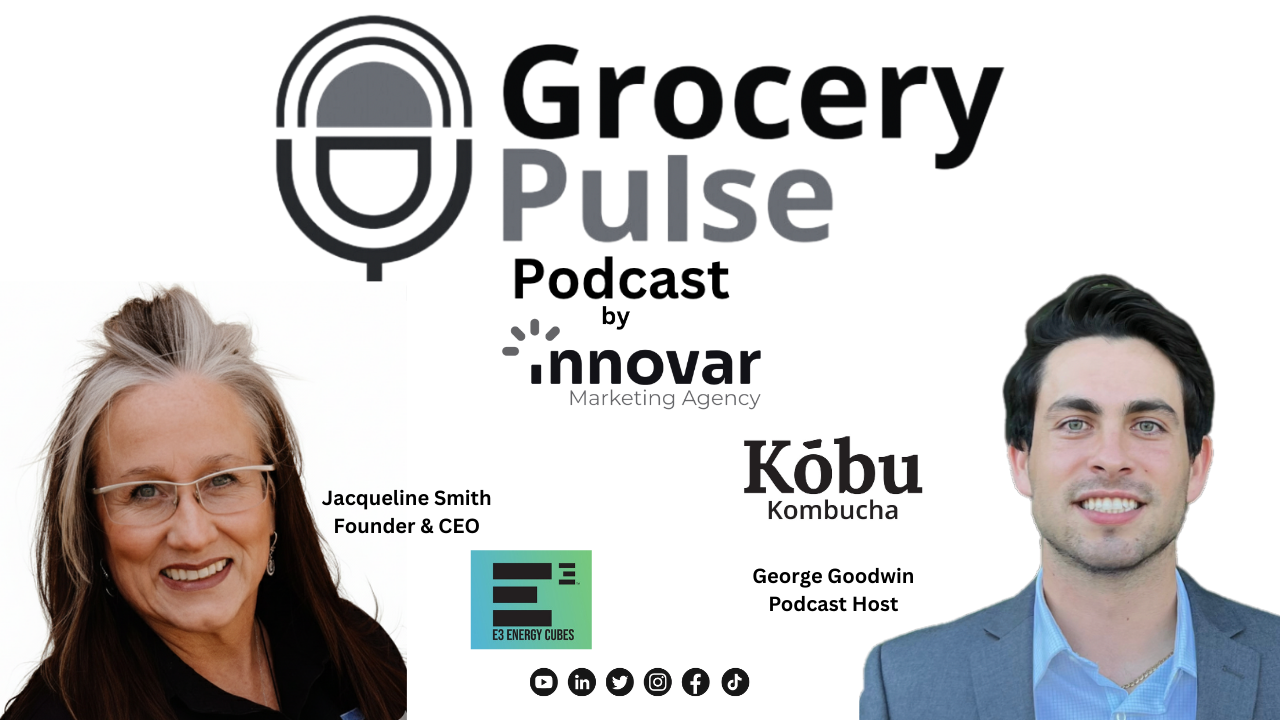
In a recent episode of Grocery Pulse, I sat down with Jacqueline Smith, the founder and CEO of E3 Energy Cubes. Her journey from being an accountant to a CPG (Consumer Packaged Goods) manufacturer is a masterclass in breaking the rules. She didn’t just bake bars in her kitchen; she bought an industrial manufacturing line before she had a single retailer. She didn’t rely on trends; she relied on math.
Here is how Jacqueline is carving out a slice of the $152 billion global healthy snack market and what grocery retailers and founders can learn from her approach.
Why This Founder Story Matters Right Now
Shoppers today are:
Reading labels more closely
Questioning sugar, seed oils, and additives
Looking for real energy, not quick spikes
“Consumers are more educated than ever about how food fuels their bodies.”
That shift is forcing both brands and retailers to rethink what “healthy” actually means—and how it shows up in stores. E3 Energy Cubes is a good example of how discipline, transparency, and smart retail thinking can win in a crowded category.
The Formula: Designing Food with Math
Most food founders start with flavor. Jacqueline started with function.
With her background in accounting, she looked at a protein bar not as a snack, but as an equation to be solved. She realized that many "healthy" bars on the market were delicious but nutritionally unbalanced, causing massive insulin spikes.
What Does E3 Stand For?
Jacqueline’s solution was E3, which stands for Energy from 3 sources:
Fats
Carbs
Proteins
"I’m not a creative person as far as cooking... most of my formula came from math. I literally was trying to find a way to make a product that fit three different things: fats, carbs, and proteins in a balanced way." — Jacqueline Smith
By "balancing the books" on nutrition, she created a bar that stabilizes energy levels. She also innovated on the form factor: the bars come in three separate squares ("cubes"), allowing consumers to dose their energy rather than committing to a giant slab.
The Manufacturing Gamble: Betting on Vertical Integration
This is where the story gets gritty. In the CPG world, the standard advice is to hire a "co-packer" (a third-party factory) to make your product. This keeps overhead low while you test the market. Jacqueline went the other way. Realizing she couldn't scale by hand-pressing bars, she flew to a packaging expo in Chicago. She bought an extruder, a flow wrap machine, and commercial freezers right then and there. She set up her own facility from Day 1.
Surviving the Pivot
Her bold move was tested immediately. In March 2020, she drove a truckload of product to Expo West—the industry's biggest event—only to have it canceled due to the pandemic. Because she owned her manufacturing, she had the agility to pivot. She used the downtime to refine her packaging, making it pop on the shelf (switching from black wrappers to bright colors), which eventually helped her land retailers like Gelson’s (27 locations in SoCal).
From Accountant to Snack Founder: Building a Bar With Math
Jacqueline doesn’t describe herself as a creative cook. She describes herself as a problem solver. She paid a food-focused creator to make an early version of a bar. It tasted great—but once she ran the nutrition numbers, she realized why. So she rebuilt it using math.
What “E3” Really Means
E3 stands for energy from three sources:
Fats
Carbs
Protein
Instead of chasing “high protein at all costs,” Jacqueline focused on balanced macros designed for longer-lasting energy without insulin spikes.
She:
Increased protein the right way
Added meaningful fiber
Removed unnecessary sweeteners like agave and brown rice syrup
Let fruit do most of the sweetening
Kept only what served a purpose
“We built a bar that tasted good, was balanced in the macros, and delivered half your daily fiber.”
That’s not marketing fluff. That’s a measurable value proposition.
What Makes E3 Energy Cubes Different on the Shelf
E3 Energy Cubes aren’t just another protein bar.
Three Cubes, Not One Brick
Each bar comes in three cubes, which makes it:
Easier to portion
Shareable
Less intimidating than dense bars
This small design decision actually improves repeat purchases—shoppers don’t feel forced to finish a whole bar at once.
Flavor Without Guilt
E3 launched with multiple flavors to avoid “protein bar fatigue,” including:
Peanut Butter Chocolate (top seller)
Lemon Blueberry
Almond Cherry
Orange Cranberry
Peanut Butter & Jam
Flavor mattered—but never at the expense of the label.
The Norris Cole Moment: When Product Does the Talking
One of the most powerful moments in Jacqueline’s journey didn’t come from a pitch deck. It came from a gut instinct. She felt strongly pulled to attend an event she didn’t need to go to. In the green room, she saw Norris Cole, a two-time NBA Champion, eating one of her bars. He told her:
“I’ve eaten protein bars my whole life. This is the best one I’ve ever had.”
When she introduced herself as the founder, he became E3’s first investor. Lesson for brands: Great product + being in the right room still beats most marketing tricks.
Clean-Label Discipline: Transparency Over Shortcuts
Jacqueline is unusually honest about ingredient sourcing—even when it’s uncomfortable.
The Seed Oil Reality
She doesn’t add seed oils to her bars. But some dried fruits are lightly sprayed with sunflower oil during processing. Instead of hiding it, she discloses it.
“Transparency matters more than claiming perfection.”
She’s actively working with suppliers to eliminate even trace sources—but only when scale and pricing allow it. For retailers, this matters. Shoppers trust brands that explain why something is there—not brands that pretend it isn’t.
Manufacturing In-House: A Bold (and Risky) Decision
Most CPG founders chase co-manufacturers. Jacqueline bought equipment. She started by hand-pressing cubes, realized it wouldn’t scale, and flew to a packaging expo where she invested in:
An extruder
A flow-wrap machine
Freezers
She was manufacturing and flow-wrapping before landing her first store. Then COVID hit.
The COVID Reality Check
In early 2020, she drove to Expo West with roughly $20,000 worth of product—only to have the show canceled. Retailers stopped onboarding new brands. Everything paused. E3 survived by:
Preserving inventory
Reworking packaging
Re-launching with clearer retail strategy
That persistence paid off.
Packaging Lesson Every Brand Should Learn
E3’s original packaging was black. It looked premium online. In-store? It disappeared. Most refrigerated sets have dark backgrounds. Black-on-black meant zero shelf visibility. So E3 switched to bright, colorful packaging for retail.
“Your online packaging is not your in-store packaging.”
If you’re a founder: remember, shoppers give you 2–3 seconds on shelf.
Where E3 Actually Wins: Retail Channels That Work
Convenience Stores (C-Stores)
E3’s biggest volume driver has been the refrigerated grab-and-go section in convenience stores—especially Circle K.
Why it works:
Shoppers expect protein-forward items
Refrigeration signals “better-for-you”
Speed + trust matters
Premium Grocery
E3 is also carried by Gelson’s, a high-end grocery chain with loyal shoppers who value ingredient quality. For retailers, E3 shows how refrigerated snacks can bridge convenience + credibility.
Practical Lessons for CPG Founders
1. Always Compare Vendor Quotes (But Do the Math)
Jacqueline sends RFPs to multiple suppliers—but often consolidates orders to reduce freight costs. Cheapest ingredient ≠ cheapest landed cost.
2. Trade Shows Can Quietly Drain Cash
Some founders spend $40K–$50K per year chasing every show. Better strategy:
Choose fewer shows
Follow up aggressively
Include product photos in buyer emails (they meet thousands of brands)
3. Finance Equipment When Possible
Jacqueline says one regret was paying cash upfront for equipment instead of financing—especially before COVID. Cash flexibility matters more than ownership pride early on.
What Grocery Retailers Can Learn From E3 Energy Cubes
If you’re a buyer or operator, E3 highlights what works:
Refrigerated snack sets build trust faster
Clear labeling reduces friction at shelf
Smaller brands need onboarding guidance, not just rules
Retailers who support emerging brands early often win exclusive access later.
The Clean-Label Discipline: Hidden Ingredients
For grocery retailers and buyers, this is a crucial insight: Clean labels aren't always clean. Jacqueline is obsessive about supply chain transparency. She highlighted how difficult it is to source truly natural ingredients.
The Dried Fruit Trap: She noted that many suppliers spray dried cherries or blueberries with sunflower oil to keep them from sticking.
The Flavor Trap: "Natural flavors" often contain carriers you wouldn't expect.
"If you know what propylene glycol is... It is antifreeze. My husband is a plumbing contractor and he buys propylene glycol by the drum... and we're putting it in our food."
The Goal: Jacqueline is currently working to eliminate all seed oils from her supply chain by Q2 2026, switching to premium avocado oil. This increases costs, but builds massive consumer trust.
Trusting Your Gut (And Meeting an NBA Champion)
Data is important, but Jacqueline credits "alignment" and intuition for her biggest break. On a gut feeling, she attended a motivational conference she felt she didn't need to go to. While hanging out in the green room, she saw Norris Cole (two-time NBA Champion) eating one of her bars. He told her it was the best bar he’d ever tasted. Because she was in the right place at the right time, Norris became her first investor.
Fun Fact: Norris Cole’s favorite flavor is Lemon Blueberry.
Key Takeaways for CPG Founders & Retailers
Healthy snacks are evolving—and shoppers are paying attention
Math-driven formulation beats hype-driven claims
Clean-label discipline builds long-term trust
Packaging must be designed for where it sells
Convenience stores are powerful for protein-forward snacks
Transparency wins—even when it’s messy
Convenience is King: E3 has found massive success in the C-Store channel (like Circle K). Consumers are no longer just buying junk food at gas stations; they are reading labels and looking for protein.
Control Quality: Owning your manufacturing is expensive and risky, but it prevents you from being at the mercy of a co-packer’s schedule or ingredient swaps.
Check Your Supply Chain: If you claim "clean label," dig deep. Ask suppliers what processing aids they use that might not appear on the final ingredient list.
Frequently Asked Questions (FAQs)
What makes E3 Energy Cubes different from other protein bars?
They’re refrigerated, come in three cubes, and focus on balanced macros instead of extreme protein numbers. Unlike standard slab bars, E3 Energy Cubes are portioned into three separate squares. Nutritionally, they are mathematically balanced across fats, carbs, and proteins to prevent insulin spikes.
Why does refrigerated placement matter?
Shoppers associate refrigerated grab-and-go with fresher, better-for-you products—and make faster trust decisions there.
Is the healthy snack market growing?
Yes. The global healthy snack market is currently valued at roughly $152 billion and is projected to hit $230 billion. This growth is driven by educated consumers who demand transparency in ingredients.
Why do some natural flavors contain propylene glycol?
Propylene glycol is often used as a solvent or carrier in flavorings. While considered "safe" by regulators in small amounts, clean-label brands like E3 work hard to ensure their natural flavorings are free from industrial solvents.
How can retailers help small brands succeed?
By offering clarity on readiness, giving honest feedback, and supporting early velocity through placement and demos.
Ready to Scale Your Brand in Grocery Retail?
Jacqueline Smith’s story proves that success requires a mix of smart math, brave risks, and a great product. But navigating the complex world of retail buyers, distribution logistics, and marketing strategy can be overwhelming. You don't have to guess your way to the shelf. Whether you are an emerging CPG brand or a retailer looking for the next big thing, let's talk strategy.
If you’re a CPG brand, grocery retailer, or food founder who wants:
SEO-driven blog content that ranks
Founder storytelling that builds trust
Retail-ready messaging that buyers understand
Content that actually supports sales conversations

🎧 Listen to GroceryPulse
🤝 Connect with the Guests
Jacqueline Smith — LinkedIn - https://www.linkedin.com/in/jacquelinebarlowsmith/
George Goodwin — LinkedIn - https://www.linkedin.com/in/number-one-marketer/
george@innovaragency.com
podcast@innovaragency.com
🌐 Explore Innovar Marketing Agency → innovaragency.com